Buoyant|Manipulating Gravity
Interactive Virtual Environment
Unity, HTC Vive

A sketch by Hilma af Klint
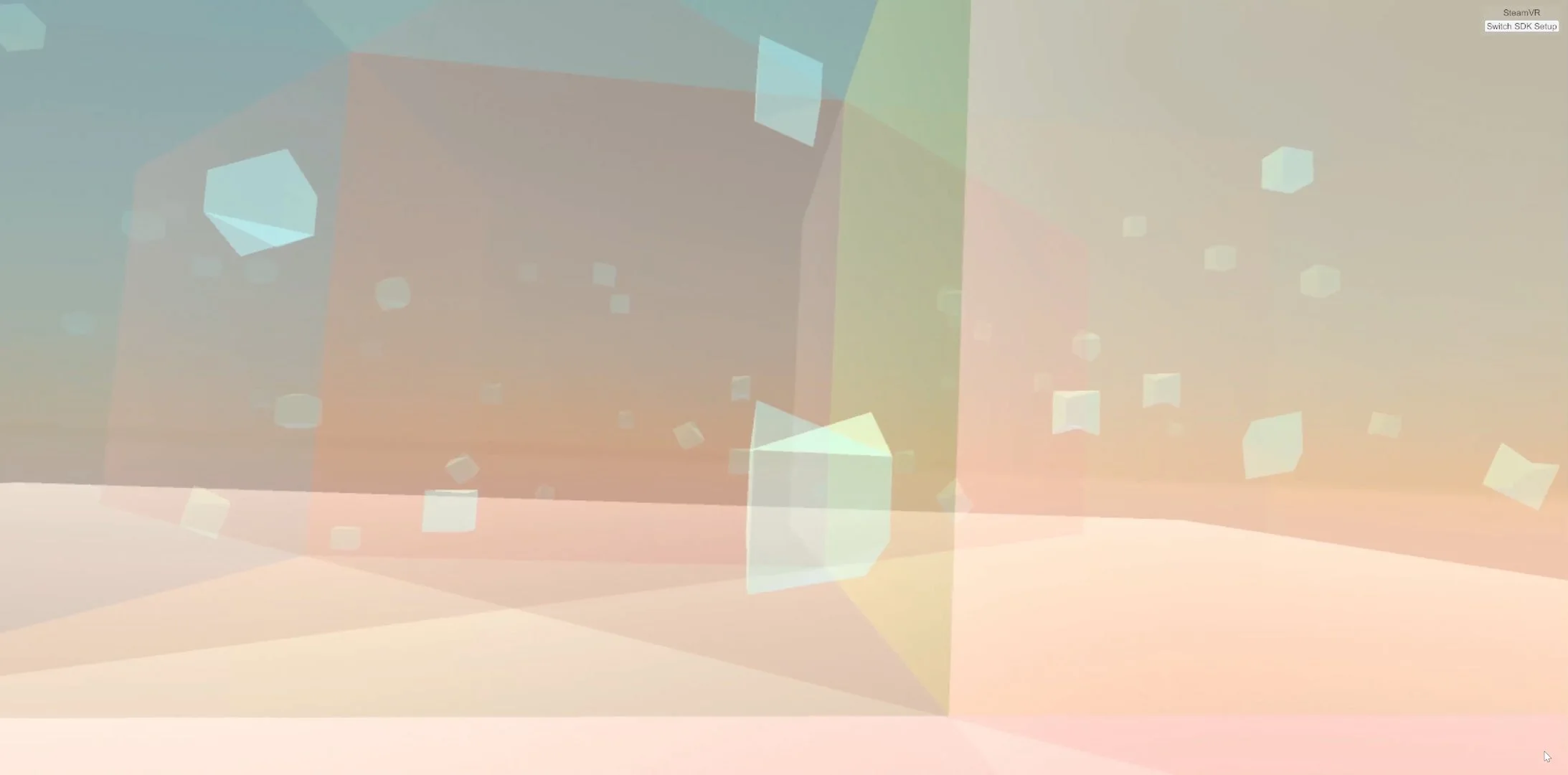
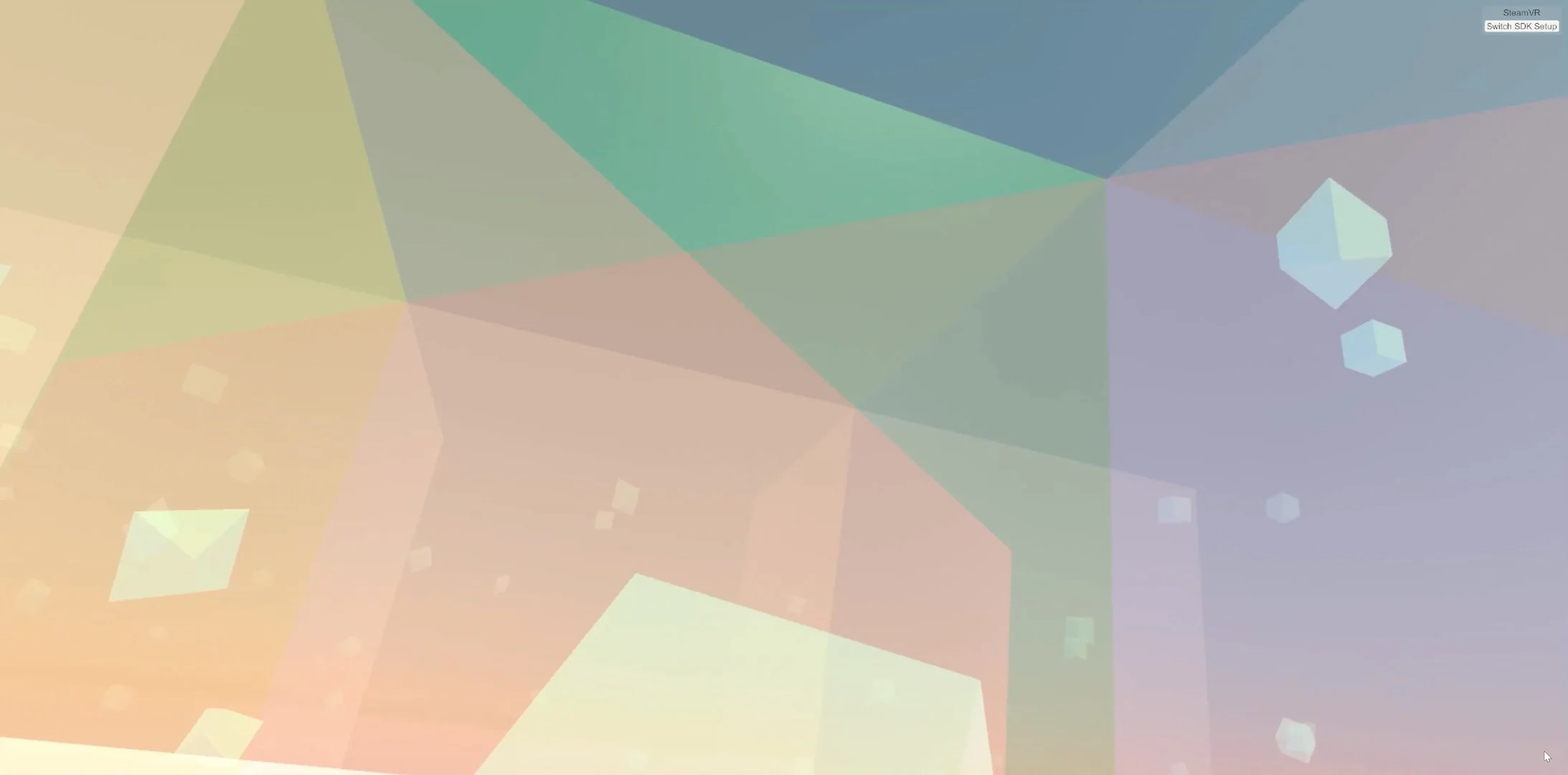
Buoyant (2018) is an interactive virtual environment composed of nine translucent rooms, each a cube-shaped volume governed by a distinct local gravity condition. The rooms are enclosed by planes—walls, floor, and ceiling—yet remain permeable. Objects moving through the environment become subject to the gravity of the room they occupy, producing shifting physical rules that are encountered through movement and perception.
Objects do not immediately reveal how they behave. Their properties become legible only through transition. An object may be carried into a neighboring room and released, or thrown directly across a boundary. In either case, the moment it enters a new room, it becomes subject to that room’s gravity. Expectations formed in one space are unsettled in the next. Gravity is not explained but learned through repeated crossings, recalibration, and embodied inference.
The spatial structure of Buoyant is derived from a sketch by Hilma af Klint depicting nine cubes arranged as a larger cubic formation. The drawing is treated as a diagram rather than a composition. Af Klint’s sketches often operate as propositions, using spatial arrangement to think through forces that cannot be seen directly. In Buoyant, the sketch provides a structural logic for organizing space around invisible conditions—states, transitions, and relationships—allowing gravity, sound, and movement to function as experiential counterparts to the forces the drawing implies.
Crossing boundaries between rooms activates discrete system responses. When an object collides with or passes through a boundary, a unique sound is triggered. These sounds persist, overlap, and gradually fade, accumulating into a continuously shifting sonic landscape. Sound is tied to state transitions rather than discrete actions, making movement through the environment audible over time. After the initial moments of interaction, the space is rarely silent.
Navigation is constrained to the ground plane. Users may point to any location on the floor and teleport there, without visible markers or predefined positions. Vertical repositioning is not possible, and gravity cannot be bypassed. This constraint keeps movement continuous and embodied, reinforcing engagement with each room’s physical rules through timing, anticipation, and perception. Traversal produces layered sequences of visual, gravitational, and sonic states, making movement itself the primary means of interaction.
Over time, interaction becomes exploratory and improvisational. Users begin to anticipate how objects will behave as they cross boundaries, treating the environment less as a space to be navigated and more as an instrument to be played. Meaning emerges through repetition, accumulation, and comparison, as perception, sound, and system behavior become increasingly coupled.